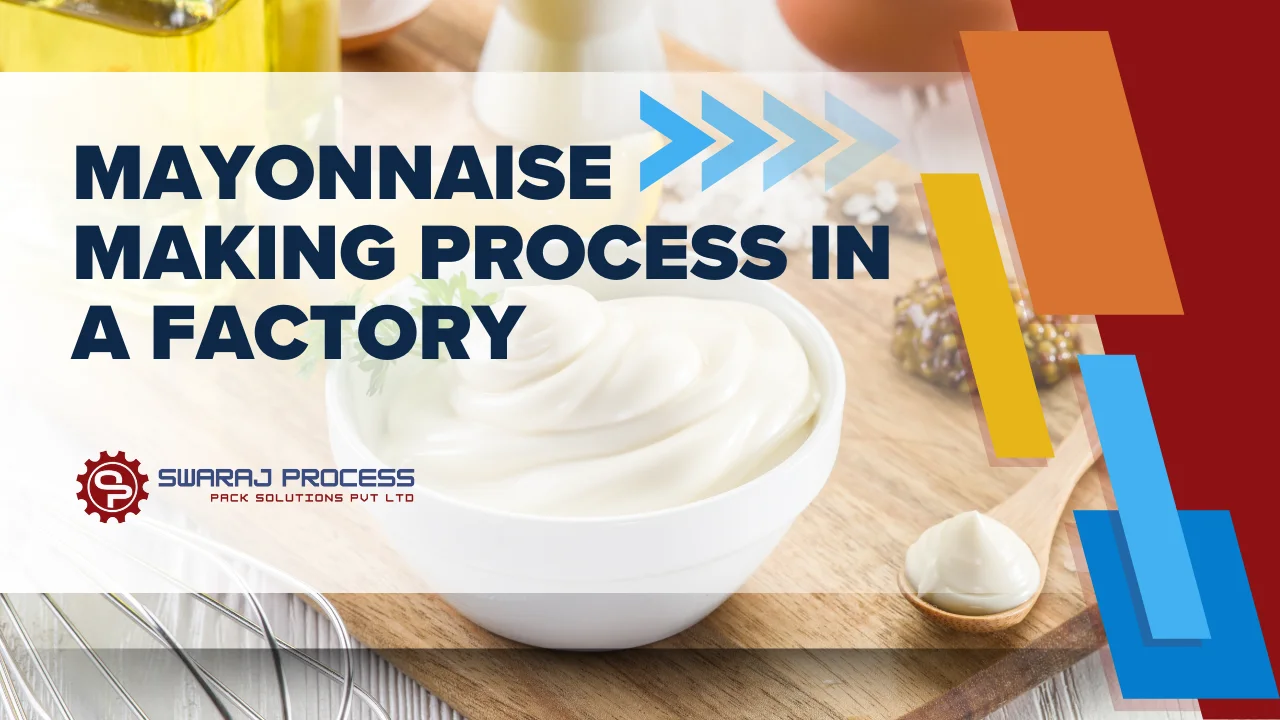
Mayonnaise is one of the most popular emulsified food products used worldwide in sandwiches, burgers, salads, dips, and ready-to-eat foods. Its smooth texture, rich taste, and long shelf life make it a staple in both households and the food processing industry. In large-scale production, mayonnaise is manufactured in controlled factory environments using advanced food processing machinery to ensure consistent quality, hygiene, and safety.
In this blog, we will explain the complete mayonnaise making process in a factory, including ingredients, machinery, quality control, and packaging, while also highlighting the role of Swaraj Process Pack, a reputed food processing machinery manufacturer.
What are Mayo made out of?
Mayonnaise is a semi-solid oil-in-water emulsion, typically made by blending vegetable oil, egg yolk or egg powder, vinegar or lemon juice, water, sugar, salt, and permitted stabilizers or emulsifiers. The key to mayonnaise is emulsification, where oil droplets are uniformly dispersed in the water phase to create a thick and creamy product.
What Ingredient do you need to make Mayonnaise?
Mayonnaise is a creamy, smooth, and flavorful emulsion made by blending a few carefully selected ingredients in the right proportion. The quality, taste, and texture of mayonnaise depend on how well these ingredients are combined. Below are the key ingredients used to make mayonnaise, explained simply and clearly:
What are the 3 Main Basic Ingredients of Mayonnaise
The foundation of mayonnaise is built on three main basic ingredients. These ingredients are essential because they create the characteristic creamy texture, rich taste, and stable emulsion that define mayonnaise. Without any one of these, mayonnaise would not form properly.
1. Vegetable Oil
Vegetable oil is the primary ingredient in mayonnaise and makes up the largest portion of the recipe. Oils such as sunflower, soybean, canola, or mustard oil are commonly used. The oil gives mayonnaise its thick, smooth, and creamy body. During mixing, the oil is broken into tiny droplets and evenly dispersed, which is what creates the rich and luxurious texture of mayonnaise.
2. Egg Yolk
Egg yolk plays the most important functional role in mayonnaise. It acts as a natural emulsifier because it contains lecithin, a compound that allows oil and water to mix together. Without egg yolk, the oil and liquid would separate. Egg yolk also adds richness, color, and flavor, making the mayonnaise smooth, stable, and consistent.
3. Vinegar or Lemon Juice
Vinegar or lemon juice provides the acidic component of mayonnaise. This acidity enhances flavor, gives mayonnaise its slightly tangy taste, and helps stabilize the emulsion. It also lowers the pH of the product, which improves food safety and extends shelf life. The balance of acidity is crucial to achieving the perfect taste and texture.
Supporting Ingredients
Salt: Enhances flavor and balances taste.
Sugar: Adds mild sweetness and balances acidity.
Mustard (optional): Improves flavor and also helps stabilize the emulsion.
Stabilizers & Thickeners: Commonly used in commercial mayonnaise to improve texture and shelf life. Examples include:
- Xanthan gum
- Guar gum
- Modified starch
Preservatives (for commercial use): Used to extend shelf life, as permitted by food safety regulations.
Flavoring Agents (optional): Garlic, herbs, spices, or other seasonings for flavored mayonnaise variants.
Ingredients in Eggless Mayonnaise
For egg-free or vegan mayonnaise, egg yolk is replaced with:
- Milk solids or plant-based proteins
- Soy protein
- Modified starches and emulsifiers
Industrial Mayonnaise Making Process in Factory
1. Ingredient Weighing and Preparation
The process begins with accurate weighing and measuring of raw materials according to the standardized recipe. Precision is essential to maintain uniform taste, texture, and consistency in every batch.
Liquid ingredients like water, vinegar, and oil are filtered before use, while dry ingredients such as sugar, salt, and stabilizers are pre-mixed to avoid lump formation.
2. Water Phase Preparation
In this stage, water is transferred into a mixing or preparation tank. Dry ingredients such as sugar, salt, stabilizers, and preservatives are added gradually under controlled agitation. Proper mixing ensures complete dissolution and activation of stabilizers, which help in improving the viscosity and stability of mayonnaise.
3. Oil Phase Preparation
The vegetable oil is stored separately in hygienic tanks. Oil quality is crucial, as it directly affects taste, color, and shelf life. The oil is filtered and sometimes pre-conditioned before emulsification.
4. Emulsification Process (Core Step)
Emulsification is the heart of mayonnaise manufacturing.
- Egg yolk or egg powder is added to the water phase.
- Oil is slowly introduced under high-speed mixing or homogenization.
- Powerful mixers break oil into tiny droplets and evenly disperse them in the water phase.
This process forms a stable, thick emulsion with a smooth and creamy texture. Advanced mayonnaise processing systems from Swaraj Process Pack are designed to achieve uniform emulsification with minimal batch variation.
5. Homogenization
After initial emulsification, the mixture may pass through a homogenizer to further reduce particle size. Homogenization improves:
- Product smoothness
- Stability
- Mouthfeel
- Shelf life
This step is especially important in large-scale commercial production.
6. pH Adjustment and Flavoring
Vinegar or lemon juice is added to adjust the pH, which is critical for:
- Taste balance
- Product safety
- Microbial control
At this stage, flavors, herbs, or spices can also be added depending on the product variant (classic, garlic, tandoori, etc.).
7. Quality Control and Inspection
Before packaging, the mayonnaise undergoes strict quality checks, including:
- Texture and viscosity testing
- pH value measurement
- Taste and aroma evaluation
- Microbiological testing
Factories using equipment from Swaraj Process Pack benefit from hygienic designs that comply with food industry standards, making quality control more efficient.
Machinery Used in Mayonnaise Manufacturing
A typical mayonnaise production line includes:
- Mixing tanks
- High-speed emulsifiers
- Homogenizers
- Storage tanks
- Transfer pumps
- Filling and packaging machines
We offers complete mayonnaise processing solutions, from preparation and emulsification to packaging, tailored to small, medium, and large-scale food manufacturers.
Advantages of Factory-Made Mayonnaise
- Consistent taste and texture
- High hygiene and food safety standards
- Large-scale production efficiency
- Longer shelf life
- Custom flavor and formulation options
Conclusion
Mayonnaise production is a carefully controlled process that relies on the perfect balance of core ingredients and precise processing techniques to achieve a smooth, stable, and flavorful product. From accurate ingredient handling to efficient emulsification and hygienic packaging, every step plays a vital role in maintaining quality and consistency at an industrial scale.
With advanced technology, hygienic design, and proven expertise, Swaraj Process Pack stands out as a leading mayonnaise making plant manufacturer, offering complete, reliable, and customized solutions for food manufacturers. Our modern mayonnaise processing plants help businesses achieve high productivity, consistent quality, and compliance with food safety standards, making them a trusted partner in the food processing industry.