

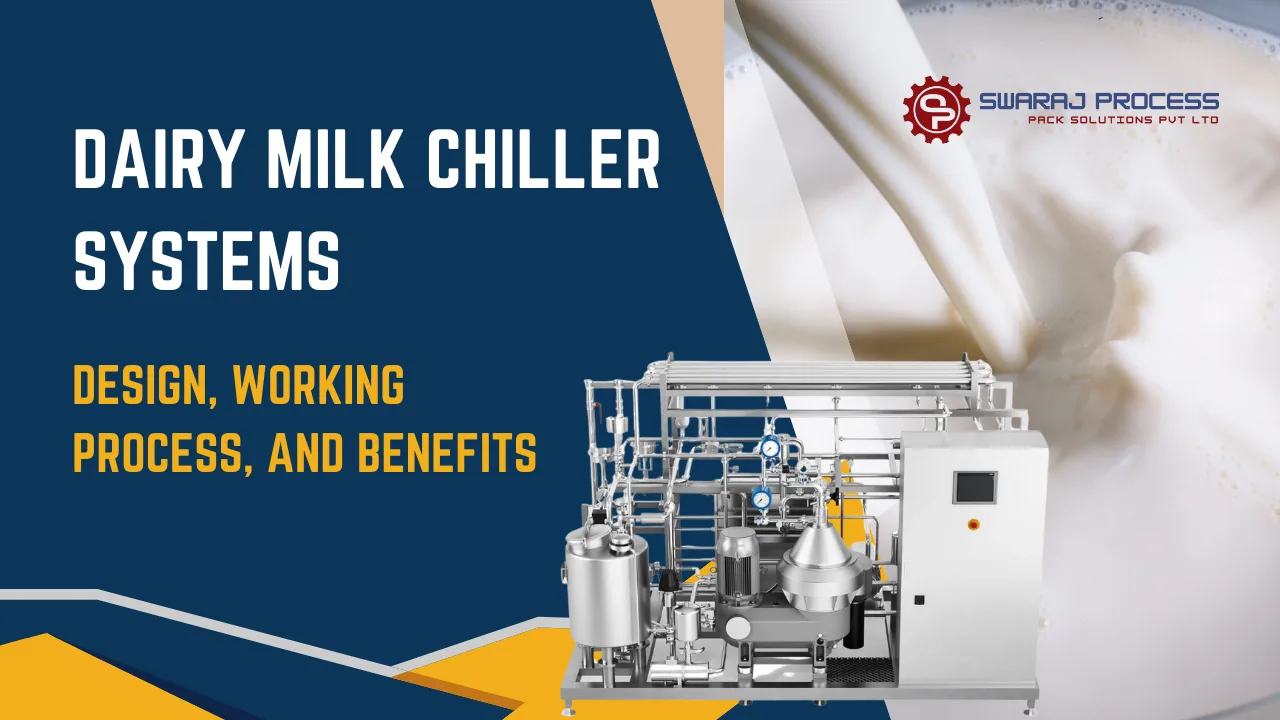
In the dairy industry, maintaining milk quality from the point of collection to processing is critical. Fresh milk is highly perishable and must be cooled quickly to prevent bacterial growth and preserve its natural properties. This is where Dairy Milk Chiller Systems play a vital role. These systems are specially designed to rapidly reduce the temperature of milk and keep it safe for storage and further processing.
Swaraj Process Pack, a trusted name in dairy and food processing equipment, offers reliable and efficient dairy milk chiller systems designed to meet modern dairy industry requirements.
What Is a Dairy Milk Chiller System?
A Dairy Milk Chiller System is a refrigeration-based system used to cool freshly collected milk to a safe storage temperature, typically around 4°C. Rapid cooling slows down bacterial activity, helps maintain milk freshness, and ensures compliance with food safety standards.
Milk chiller systems are widely used in:
- Dairy farms
- Milk collection centers
- Bulk milk cooling units
- Dairy processing plants
Importance of Milk Chilling in the Dairy Industry
Fresh milk comes out of the animal at a temperature of approximately 35–37°C. If not cooled quickly, bacteria multiply rapidly, affecting taste, quality, and shelf life. Proper chilling:
- Preserves milk quality
- Prevents spoilage
- Maintains nutritional value
- Reduces rejection at processing plants
Milk chiller systems ensure that milk remains safe and usable until it reaches the processing stage.
Design of Dairy Milk Chiller Systems
The design of a dairy milk chiller system focuses on efficiency, hygiene, and durability. Swaraj Process Pack designs milk chiller systems using high-quality materials and proven engineering principles.
Key Design Components
Milk Storage Tank
- Made from food-grade stainless steel (SS 304 / SS 316)
- Ensures hygiene and corrosion resistance
- Available in different capacities to suit small to large dairy operations
Cooling Jacket or Evaporator
- Surrounds the milk tank or is integrated within it
- Allows efficient heat transfer from milk to the refrigerant
- Ensures uniform cooling without freezing
Refrigeration Unit
- Includes compressor, condenser, expansion valve, and evaporator
- Designed for continuous and energy-efficient operation
- Uses eco-friendly refrigerants
Agitator System
- Gently stirs the milk
- Prevents cream separation
- Ensures uniform temperature throughout the tank
Control Panel
- Digital temperature control
- Automatic start/stop functions
- Safety features for overload and temperature protection
Working Process of Dairy Milk Chiller Systems
The working of a dairy milk chiller system is based on the principle of heat exchange and refrigeration.
Step-by-Step Working Process
Milk Collection: Fresh milk is transferred into the stainless-steel milk chiller tank immediately after milking.
Cooling Initiation: The refrigeration system starts automatically when milk enters the tank.
Heat Removal: The evaporator or cooling jacket absorbs heat from the milk, lowering its temperature rapidly.
Refrigerant Cycle:
- The compressor compresses the refrigerant
- The condenser releases heat to the atmosphere
- The expansion valve reduces pressure
- The evaporator absorbs heat again from the milk
Uniform Cooling: The agitator continuously stirs the milk to maintain even cooling and consistent quality.
Temperature Maintenance: Milk temperature is maintained at around 4°C until it is dispatched for processing.
Types of Dairy Milk Chiller Systems
- Bulk Milk Chillers (BMC)
- Direct Expansion Milk Chillers
- Ice Bank Milk Chillers
- Vertical and Horizontal Milk Chiller Tanks
Swaraj Process Pack provides customized solutions based on capacity, site conditions, and operational requirements. Our dairy milk chiller systems are available in a wide range of capacities such as 100 ltr, 200 ltr, 300 ltr, 500 ltr, 1000 ltr, 1500 ltr, 2000 ltr, 2500 ltr, 3000 ltr and higher, ensuring suitability for small to large-scale dairy operations.
Benefits of Dairy Milk Chiller Systems
- Preserves Milk Quality: Rapid cooling prevents bacterial growth and maintains freshness, taste, and nutritional value.
- Extended Shelf Life: Chilled milk can be stored safely for longer durations without quality loss.
- Improved Food Safety: Maintains hygiene standards and meets dairy regulatory requirements.
- Energy Efficient Operation: Modern chiller systems are designed for low power consumption and high performance.
- Reduced Milk Rejection: Consistent cooling ensures better acceptance at dairy processing plants.
- Easy Operation and Maintenance: User-friendly controls and robust construction ensure long service life.
Applications
- Dairy farms
- Village milk collection centers
- Cooperative dairies
- Commercial dairy processing plants
- Milk chilling units and cold storage facilities
Conclusion
Dairy milk chiller systems are an essential part of modern dairy operations. From preserving milk quality to ensuring food safety and extending shelf life, these systems play a crucial role in the dairy value chain. A well-designed milk chiller system not only protects milk but also enhances operational efficiency.
By choosing a trusted Milk Chilling Plant manufacturer like Swaraj Process Pack, dairy operators can invest in reliable, efficient, and long-lasting milk chilling solutions that support sustainable dairy production.